
In October we replaced the pool mastic on a backyard pool in Turtle Rock, Irvine 92603. On paper it was a routine job: 176 linear feet of expansion joint, one day on site, finished in tan premium sanded. In practice, the coping was natural flagstone, and flagstone asks more of a crew than a straight run of poured concrete ever does.
This is how that job went, step by step, and what it means if your own pool is edged in stone.
The pool
The pool is ringed with natural flagstone coping laid with sandstone pavers, and the deck beyond it is exposed aggregate concrete. The expansion joint runs where the stone meets the deck. It is the deliberate gap that lets the pool shell and the slab move independently, and the mastic in it has two jobs: flex with that movement and keep water out of the soil underneath. If you want the full picture of what wears that seal out, we covered it in why pool expansion joints fail in Southern California.
Why flagstone changes the job
Poured concrete coping gives you a straight, uniform edge. Flagstone does not. Every piece is cut and set by hand, so the face of the joint wanders: wider in one spot, tighter in the next, with small steps where one stone sits a little proud of its neighbor. That shows up at three points in the work.
- Removal. Old mastic grips into every pit and ledge of a natural stone face. It has to come out of all of them, not only the straight sections.
- Depth. A joint that changes width needs backer rod sized to the joint we actually find, not one standard size for the whole run.
- Finish. The bead sits right against stone the owner chose for its color. A seal that fights that color reads as a stripe around the entire pool.
None of this is exotic. It simply punishes shortcuts, and stone coping is where a rushed install shows first.
Step 1: full removal, wall to wall
The old mastic came out of all 176 feet, not just the stretches that looked worst.
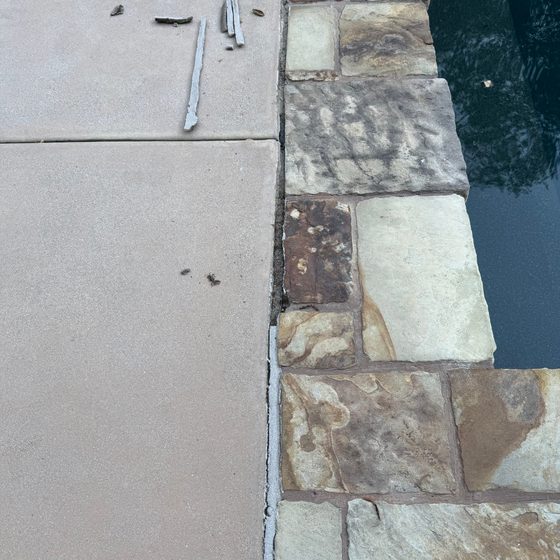
This is the step patch jobs skip. New sealant does not bond to old, so anything left behind in the joint becomes the weak layer the new bead peels away from later. Full removal is slower, and it is the only version of this job worth paying for.
Step 2: cut back to sound concrete
With the joint open, both faces were cut back to sound concrete. On the deck side that means taking off the chalky, contaminated skin so the sealant bonds to a fresh, textured surface. On the stone side it means clearing residue out of the natural pits instead of sealing over it. Then the joint was cleaned out completely, because dust is the other thing sealant refuses to stick to.
Step 3: backer rod at the right depth
Backer rod is the foam cord pressed into the joint before any sealant goes in. It sets how deep the mastic sits, and it keeps the sealant from bonding to the bottom of the joint, so the bead grips only the two faces and can stretch between them as the pool and deck move. On a flagstone joint the rod is sized to the width as we go. You will never see it once the job is done, and it does more to decide how long the joint lasts than anything you can see.
Step 4: one continuous pass in tan
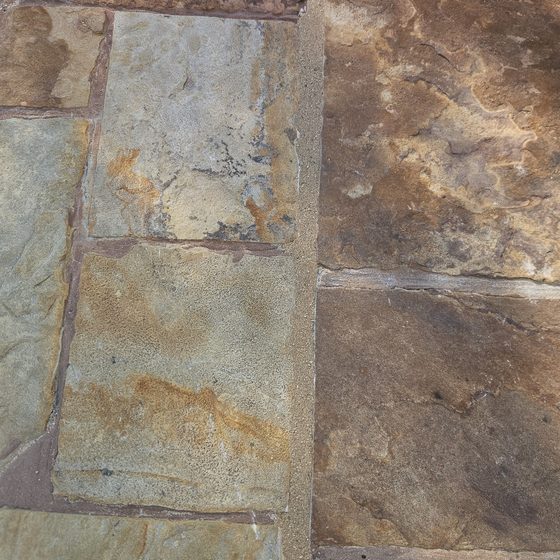
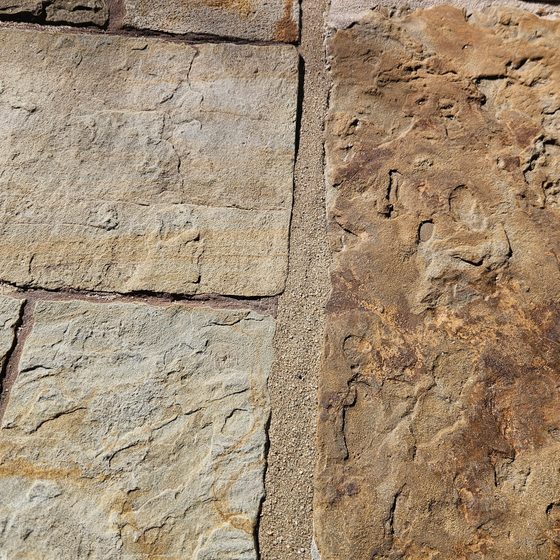
The sealant went in as a single continuous pass and was tooled just below the surface, so it sheds water and stays clear of feet and furniture.
Why tan, not grey
We offer two finishes, grey and tan, both premium sanded. The sand is doing real work: it keeps the surface grippy when the deck is wet, and it gives the bead a texture far closer to stone than smooth caulk.
Grey is the natural choice beside most concrete coping. Here, though, the coping and pavers are warm flagstone and sandstone, and a grey line would have outlined every stone around the pool. Tan sits with the stone. Our working rule on color is simple: match the coping, not the deck.
After the crew left
The work was finished in one day. New mastic needs at least 48 hours to cure before anyone swims, so the pool stayed closed for that window. The joint is covered by our written 2 year warranty, and nothing was owed until it was finished and walked.
In Southern California a properly installed joint usually gives five to seven years of service, less where the deck takes full afternoon sun. Irvine adds expansive clay soil, which swells and shrinks with the seasons and keeps the joint working harder still. Our pool mastic replacement in Irvine page covers what we look for in local pools.
If your pool has flagstone coping
Four questions worth asking any contractor before they touch your joint:
- How does the old mastic come out? The answer you want is full removal, wall to wall. Anything less is a patch.
- Do you use backer rod, and how do you size it? If the answer is vague, the depth is a guess.
- Can I see both colors against my coping, in daylight?
- Is the price fixed before you schedule? Ours is quoted per linear foot and set in writing, so it does not move on the day.
The full process is laid out on our pool mastic replacement page, and you can see this job alongside others in our recent work.
Common questions
How is a flagstone pool joint priced?
By the linear foot, with a fixed quote sent before we schedule. Text us a photo of your joint and an idea of its length, and you will know the number before anyone arrives.
Can you match the mastic to my stone exactly?
We offer two colors, grey and tan, both premium sanded. Neither is a custom tint, but on most natural stone one of the two sits comfortably. On this Turtle Rock pool, tan was the clear choice.
How soon can we swim after the joint is replaced?
The pool cannot be used on the day of service, and the new mastic needs at least 48 hours to cure. Our pool mastic and pool caulking FAQ covers the rest of the timeline.
Text us a photo of the joint and we will tell you honestly whether it needs work yet. Pool Mastic Pros replaces pool expansion joints across Southern California in one day, backed by a written 2 year warranty. CSLB #924754. Request a call back or call (949) 374 8853.