
Most homeowners assume their pool expansion joint failed because it got old. Age plays a part, but it is rarely the whole story. Southern California works a pool joint harder than most people realize, and when one fails early, there is almost always a cause you can name.
That cause matters more than the crack itself. It decides whether your next joint lasts the full five to seven years or lets go again in two.
First, what the pool expansion joint is doing
Your pool shell and your concrete deck are two separate structures, poured at different times, sitting on different foundations. They expand, contract and settle at different rates. The expansion joint is the deliberate gap between them that lets each one move without cracking the other.
The flexible seal in that gap, the pool mastic, has two jobs at once: stretch and compress with the movement, and keep water out of the soil under your deck. It fails the moment it can no longer do one of them. These are the five causes behind most failed joints across Orange County, Los Angeles, San Diego and the Inland Empire.
1. The sun cooks the mastic
Ultraviolet light is the single biggest enemy of any joint sealant. Year after year of direct Southern California sun breaks down the surface of the mastic, and it slowly loses the elasticity that makes it work. Soft, rubbery sealant turns hard and chalky.
Hard mastic cannot stretch. So the next time the deck pulls away from the coping, instead of flexing, the seal splits down the middle or tears off one edge. That is why the stretch of joint that bakes in afternoon sun almost always fails before the shaded side of the same pool.

2. Your concrete moves every single day
Concrete grows when it heats up and shrinks when it cools. On a clear summer day a deck can go from cool at sunrise to too hot for bare feet by mid afternoon, then cool again overnight. Every one of those cycles opens and closes your expansion joint a little.
Over a five to seven year service life, that adds up to roughly two thousand cycles. A properly installed joint is built for it. A joint that is too thin, too shallow or already hardened by the sun is not, and the daily cycle is what finally pulls it apart.
3. Expansive clay soil under the deck
Much of Southern California sits on expansive clay soil, which swells when it gets wet and shrinks as it dries. Rain, sprinkler overspray and pool splash out all feed it water, and long dry spells pull that water back out.
As the soil swells and shrinks, the deck slabs ride up and down with it while the pool shell stays put. That vertical movement shears the joint in a way daily heat cycles do not. If you see deck slabs sitting at slightly different heights near the pool, or the gap at the coping getting wider on one side, soil movement is part of what is happening. It is also why a failed joint makes things worse: every drop that gets past it lands right where the soil is most sensitive. We break down that chain reaction in the real cost of ignoring a failed pool joint.
4. The original install cut corners
This is the cause homeowners rarely hear about, and it is the one most likely to make a joint fail years early. A pool expansion joint is only as good as the way it was installed. The usual shortcuts:
- No backer rod. Backer rod is a foam rope pressed into the joint before the sealant goes in. It sets the right depth and stops the sealant from sticking to the bottom of the gap. Without it, the mastic bonds on three sides, cannot stretch, and tears itself apart.
- The wrong product. Hardware store caulk looks the same in the tube but is not built for a sun baked pool deck that moves every day. We explain the difference in pool mastic vs caulk.
- New sealant laid over old. Fresh mastic does not bond to aged, oxidized mastic. A patch over the top looks fine for a season, then peels off with the old layer underneath it.
- Dirty or smooth joint faces. Sealant bonds to clean, textured concrete, not to dust, old residue or a polished edge. Skip the prep and the seal lets go from the side, exactly like the joint below.
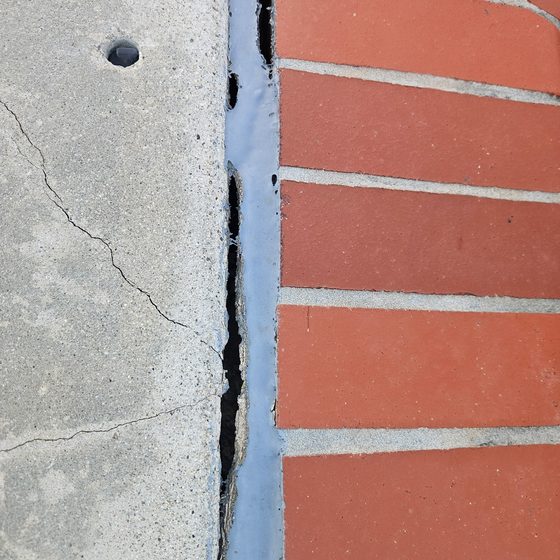
5. Pool chemicals, pressure washers and acid washes
Chlorinated water splashing onto the deck, harsh deck cleaners and acid washing all attack the surface of the sealant over time. A pressure washer held too close can cut straight into a joint that is already hardening. On their own, these rarely fail a healthy joint. Combined with the causes above, they speed everything up.
How to check your own pool expansion joint in five minutes
Walk the full perimeter of the pool on a dry day and look closely at the joint between the coping and the deck.
- Press it with your thumb. Healthy mastic gives slightly. Rock hard means it can no longer flex.
- Run a finger along both edges. Any gap between the mastic and the coping or the deck is a path for water.
- Look for splits down the center, missing sections or visible soil.
- Check the sunniest stretch first. It almost always fails before the rest.
- Look at the deck itself for slabs at uneven heights or new cracks near the pool.
For a closer look at each of these, read how to know when your pool mastic needs replacing.
What a repair that lasts actually looks like
If the cause of failure was a shortcut, repeating that shortcut gets you the same result. A proper pool expansion joint repair addresses every cause it can control:
- The old mastic comes out wall to wall, never a patch over what is already failing.
- Both faces of the joint are cut back to clean, textured concrete so the new seal has something to grip.
- New backer rod sets the correct depth, so the sealant bonds on two sides and can stretch.
- Premium sanded sealant goes in as one continuous pass, tooled below deck level, in grey or tan to suit your coping. Here is how that looks on a flagstone pool in Irvine.


You cannot change the sun or the soil, but a joint built this way is designed to absorb them instead of fighting them. Most residential pools are done in a single day, and the new joint needs 48 hours to cure before swimming. Whether you call it pool mastic replacement or pool caulking replacement, it is the same job, and the prep is what decides how long it lasts.
Common questions
Can I just run a bead of caulk over the crack?
You can, but it will not last. New sealant does not bond to old, so a bead laid over the top peels away with the failing layer underneath it, often within a season. Worse, it hides the problem while water keeps getting in.
How long should a pool expansion joint last in Southern California?
Five to seven years is the usual service life for pool mastic here, shorter on a deck in full afternoon sun. Check it every spring and you will catch a failing joint before the water does.
Is a failed expansion joint an emergency?
Not on day one, but it never stays small. The longer water runs into the soil under your deck, the more likely a cheap joint replacement turns into slab or coping repair. Our pool mastic and pool caulking FAQ answers 28 more questions like this.
Text us a photo and we will tell you honestly what caused it and whether it needs work yet. Pool Mastic Pros replaces failed pool expansion joints across Southern California in one day, backed by a written 2 year warranty. Request a call back or call (949) 374 8853.